

Missing a single large whale transaction can mean the difference between catching a 15% move and watching it from the sidelines. Most traders assume more alerts equal better decisions, but unfiltered data feeds create noise that triggers costly missteps just as often as profitable ones. This guide cuts through that problem directly, covering what crypto data aggregation actually means, which tools deliver reliable results, how to build a layered workflow, and how to filter signals so only the actionable ones reach your decision point. Every step is grounded in empirical benchmarks and practical mechanics used by advanced traders.
Table of Contents
- What is crypto data aggregation and why does it matter?
- The essential tools for advanced crypto data aggregation
- How to set up an effective crypto data aggregation workflow
- Filtering noise and interpreting whale signals for actionable trades
- Verifying signals: combining data aggregation with technical and fundamental analysis
- What most traders get wrong about crypto data aggregation
- Upgrade your trading edge with real-time crypto data aggregation tools
- Frequently asked questions
Key Takeaways
| Point | Details |
|---|---|
| Multi-source is key | Reliably aggregating data from several leading platforms vastly outperforms relying on single unfiltered feeds. |
| Filter out noise | Effective whale tracking requires aggressive filtering and context analysis to avoid costly false positives. |
| Layer your analysis | Synthesizing orderbook, on-chain, and technical data leads to much higher trade reliability and win rates. |
| Verification matters | Never act on first alerts—always confirm signals with multi-layer checks and real market context. |
What is crypto data aggregation and why does it matter?
Crypto data aggregation is the process of collecting, normalizing, and combining raw blockchain data, exchange orderbooks, wallet flows, and sentiment feeds into a unified, structured view. It goes far beyond a simple price feed. A price feed shows you where an asset is trading. Aggregated data shows you why it may be about to move.
The difference matters enormously at the execution level. When a trader relies on a single exchange feed or an unfiltered alert stream, they are seeing one dimension of a multi-dimensional market. Poor aggregation leads to acting on incomplete signals, which produces avoidable losses and missed entries.
| Data type | What it captures | Why it matters |
|---|---|---|
| On-chain transactions | Wallet transfers, DeFi interactions | Reveals accumulation or distribution |
| Exchange inflows/outflows | Net deposits and withdrawals | Signals potential sell or buy pressure |
| Orderbook depth (DOM) | Bid/ask walls, delta | Confirms or contradicts on-chain moves |
| Social sentiment | Twitter, news, LunarCrush | Provides narrative context |
| Wallet clustering | Labeled entity grouping | Identifies known whale or institutional wallets |
Advanced traders aggregate across all five layers for a specific set of reasons:
- Reduce false positives from single-source alerts
- Avoid FOMO triggered by isolated large transactions
- Detect accumulation patterns before price reacts
- Separate custody or OTC moves from real market intent
- Improve timing by correlating on-chain data with orderbook shifts
The mechanics of whale tracking involve monitoring transactions above $1 million, applying wallet clustering and labeling, tracking exchange inflows and outflows, and flagging DeFi interactions, all through blockchain explorers, APIs, and real-time alert systems.
Empirical data reinforces why aggregation quality matters. Whale alert win rates sit at just 46% in isolation, while combined DOM and delta analysis reaches a 71% win rate with a 1.14% average move. CoinGecko reports 99.2% price accuracy, yet accuracy alone does not guarantee insight without proper aggregation and filtering. For a broader view of available solutions, see the best whale tracking tools and top crypto data aggregators currently used by active traders.
The foundational principles of whale tracking apply across all aggregation setups: reliable data sourcing, consistent labeling, and multi-layer confirmation are non-negotiable for professional-grade decision-making.
The essential tools for advanced crypto data aggregation
With a clear understanding of what aggregation means, the next logical step is identifying which platforms and APIs actually deliver reliable results at the speed and accuracy advanced traders require.
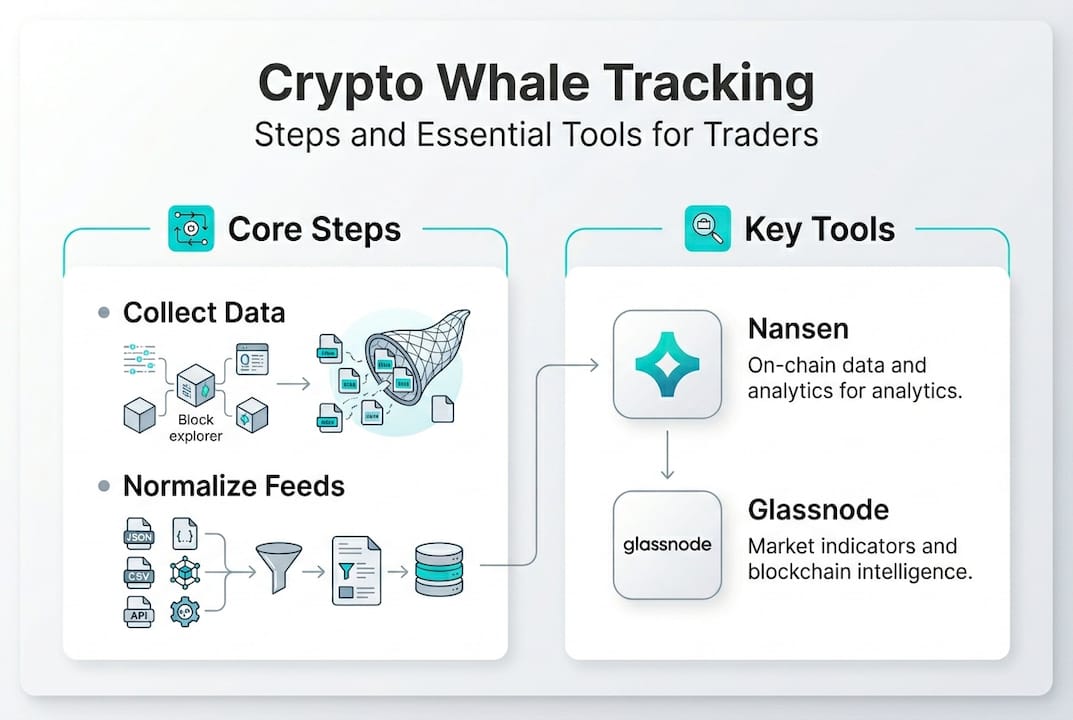
The leading platforms each bring distinct strengths. Nansen excels at wallet labeling and entity clustering. Glassnode provides deep on-chain metrics including realized cap, SOPR, and exchange net flow. CoinGecko offers broad market data with 99.2% price accuracy. Sonar Tracker combines real-time whale alerts, AI-generated signals, and multi-blockchain coverage in a single dashboard.

| Platform | Wallet labeling | Real-time alerts | Orderbook data | Free tier |
|---|---|---|---|---|
| Nansen | Yes | Yes | No | Limited |
| Glassnode | Partial | Yes | No | Limited |
| CoinGecko | No | No | No | Yes |
| Sonar Tracker | Yes | Yes | Yes | Yes |
When selecting tools, prioritize these features:
- Wallet clustering and entity labeling for context
- Real-time alerts with configurable thresholds
- Seven-day smoothed flow analysis to filter one-off transactions
- Multi-exchange orderbook integration
- Audited API feeds with documented accuracy benchmarks
For tracking crypto whale movements across specific chains, dedicated trackers add precision. An Ethereum whale tracker surfaces large ERC-20 and ETH transfers with wallet context, while a Solana whale tracker captures high-velocity SPL token flows that standard aggregators often miss.
Pro Tip: Always verify a platform's stated accuracy against audited benchmarks before integrating its API into a live workflow. Unaudited feeds introduce systematic error that compounds across aggregated layers and distorts signal quality.
The established sources for reliable aggregated data include Nansen, Glassnode, CoinGecko, and CoinMarketCap. Avoid building workflows around unfiltered alert feeds that lack entity labeling or accuracy documentation.
How to set up an effective crypto data aggregation workflow
After choosing your tools, it is time to build a workflow that processes and layers these data points for practical, actionable insights. A structured setup prevents the most common failure mode: reacting to isolated signals without context.
- Connect primary API feeds. Start with CoinGecko or CoinMarketCap for baseline price and volume data. Add Nansen or Glassnode for on-chain metrics. Integrate Sonar Tracker for real-time whale alerts and AI signals across multiple blockchains.
- Layer on-chain data with orderbook data. On-chain transfers confirm intent; orderbook depth confirms execution capacity. Neither layer is sufficient alone. Configure your dashboard to display both simultaneously.
- Set up wallet clustering and labeling. Assign entity labels to wallets you monitor regularly. Known exchange wallets, institutional custodians, and historically active whale addresses should be tagged so alerts carry immediate context.
- Establish tiered alert thresholds. Set low-priority alerts for transactions between $1 million and $5 million, and high-priority alerts above $10 million. This prevents alert fatigue while ensuring large moves are never missed.
- Automate seven-day flow analysis. Single transactions are unreliable signals. Automating cumulative flow calculations over a rolling seven-day window filters out one-off moves and surfaces genuine accumulation or distribution trends.
- Log and review all alerts weekly. Tracking which alerts led to price moves and which did not builds a feedback loop that sharpens your filtering criteria over time.
For detailed guidance on monitoring specific addresses, the tracking whale wallets resource covers labeling strategies and alert configuration in depth.
Pro Tip: Automate seven-day cumulative flow calculations in your dashboard. This single step eliminates the majority of one-off noise and significantly improves the signal-to-noise ratio across your entire alert feed.
Caution: Not every large on-chain transfer represents a market-moving event. Custody transfers between institutional wallets and OTC settlement transactions frequently appear as large moves but carry no directional implication. Always check wallet labels and whale signal win rates before acting.
Filtering noise and interpreting whale signals for actionable trades
With your workflow running, the biggest challenge is separating genuine buy and sell signals from misleading noise and false positives. The volume of alerts generated by even a well-configured system is substantial. Most of it is not actionable.
Use this checklist to validate a whale signal before acting:
- Wallet history: Has this address transacted before major price moves? New wallets with no history are lower confidence.
- Transaction pattern: Is this a single large move or part of a sustained flow over multiple days?
- Exchange context: Is the transfer moving toward an exchange (potential sell) or away from one (potential accumulation)?
- Orderbook confirmation: Does the orderbook show thinning ask walls or increasing bid depth consistent with the on-chain signal?
- Cycle position: Does the signal align with the current macro cycle phase, or does it contradict broader trend data?
- Entity label: Is the sending or receiving wallet tagged as a known custodian, OTC desk, or exchange cold wallet?
The data on signal actionability is sobering: only 8 to 12% of whale alerts are genuinely actionable after proper filtering. Cumulative seven-day flows consistently outperform single transaction alerts as predictors. Context, including cycle position and wallet history, is essential to avoid signal traps.
The nuance around large transfers is equally important. Approximately 89% of large transactions are custody moves, OTC settlements, or internal transfers with no direct market impact. There is also a documented 47-minute median lag between on-chain activity and orderbook impact, which means reacting immediately to a raw alert often means entering after the move has already begun.
For chain-specific interpretation, SOL whale movement analysis illustrates how Solana's high transaction throughput requires tighter filtering thresholds than slower chains. The complete whale signal framework details how to layer all these filters into a coherent operating system.
Verifying signals: combining data aggregation with technical and fundamental analysis
Recognizing valid signals is half the battle. The other half is confirming their reliability before placing trades. Aggregated whale data alone, even when filtered correctly, does not constitute a complete trade thesis.
Combining aggregation with technical analysis and fundamental context raises win rates materially. Whale data is most reliable for identifying positioning and accumulation trends rather than precise short-term entry points. Overreliance on whale signals without TA confirmation exposes traders to manipulation and spoofing.
Follow these steps to verify an aggregated signal before execution:
- Confirm the on-chain signal using wallet labels, seven-day flow trend, and exchange context.
- Check orderbook depth for bid support or ask thinning consistent with the on-chain direction.
- Apply technical indicators including RSI, volume profile, and key support or resistance levels to assess entry timing.
- Review macro fundamentals such as interest rate environment, regulatory news, and sector rotation trends.
- Size the position according to signal confidence, not alert size. A $50 million transfer with weak TA confirmation warrants a smaller position than a $10 million transfer with strong multi-layer alignment.
| Signal type | Win rate estimate | Recommended action |
|---|---|---|
| Raw whale alert only | ~46% | Observe only |
| Filtered multi-layer on-chain | ~60-65% | Small position, tight stop |
| TA cross-checked aggregation | ~70%+ | Standard position sizing |
| Full multi-layer confirmation | Highest | Execute with defined risk |
For ongoing research and updated signal frameworks, the crypto insights blog covers emerging patterns across major blockchains.
What most traders get wrong about crypto data aggregation
The prevailing assumption among traders new to aggregation is that more data sources automatically produce better decisions. In practice, the opposite is often true. Adding unfiltered feeds without a clear synthesis framework increases noise faster than it increases insight.
The traders who extract consistent edge from aggregation are not the ones monitoring the most wallets. They are the ones who have built disciplined filtering systems and, critically, who resist acting on the first alert. Ignoring the initial signal and waiting for multi-layer confirmation is a genuinely advanced skill. It runs counter to the urgency that raw alert feeds create, which is precisely why most traders never develop it.
Volume of data is not a proxy for quality of analysis. Synthesis and filtering, applied consistently, matter more than the number of sources connected. The in-depth whale tracking guide outlines how to build that synthesis discipline systematically. Alert-chasing burnout is real, and it typically results from mistaking high alert volume for high signal quality. The structured, layered approach described throughout this guide is the practical antidote.
Upgrade your trading edge with real-time crypto data aggregation tools
For traders ready to put these techniques into practice, Sonar Tracker provides the infrastructure to automate, monitor, and act on aggregated whale data without building a custom stack from scratch.

The platform's real-time wallet tracker monitors large transactions across multiple blockchains and delivers labeled, contextualized alerts directly to your dashboard. The AI crypto analyst powered by ORCA 2.0 layers machine learning signals on top of raw on-chain data, filtering noise automatically and surfacing only high-confidence opportunities. For traders building their analytical foundation, the on-chain analysis glossary provides precise definitions for every metric and data type covered in this guide. Sonar Tracker's zero-cost access to institutional-grade analytics means the edge described here is available immediately.
Frequently asked questions
What is the most reliable source for aggregated crypto whale data?
Reputable platforms like Nansen, Glassnode, CoinGecko, and Sonar Tracker offer accurate, audited aggregated data for whale tracking. Established sources with documented accuracy benchmarks are the only reliable foundation for a professional aggregation workflow.
How can I avoid false signals when tracking whale transactions?
Always filter alerts using wallet history, seven-day cumulative flows, orderbook confirmation, and cycle context. Only 8 to 12% of alerts are actionable after rigorous filtering, making multi-layer validation essential before any trade execution.
Why does data aggregation provide an edge for crypto traders?
Aggregating and filtering data from multiple tools sharply reduces noise and increases actionable insight accuracy. Combined DOM and delta analysis achieves a 71% win rate versus 46% for raw whale alerts alone, demonstrating the measurable value of layered aggregation.
Is real-time whale tracking useful for short-term trading?
Whale data is better suited for identifying momentum and accumulation trends than for micro-timing scalp entries. Combining whale signals with technical indicators and fundamental context produces more reliable execution timing than whale data used in isolation.
Recommended
- Blog — Whale Tracking Guides & Crypto Insights | Sonar Tracker Crypto
- Top 10 Crypto Whale Tracking Tools Compared (2026) | Sonar Tracker Crypto
- Ethereum Whale Tracker — Real-Time ETH Whale Alerts | Sonar Tracker | Sonar Tracker Crypto
- How to Track Crypto Whale Movements: Complete 2026 Guide | Sonar Tracker Crypto