

Despite the flood of on-chain data available to traders today, most still misread or miss critical signals at the worst possible moments. Crypto market anticipation is not simply about having access to more data. It is about knowing which signals to trust, how to combine them, and when to act before the crowd moves. Single on-chain metrics can be unreliable, often delivering false signals during periods of heightened volatility. This article breaks down what market anticipation actually means, which data sources carry real weight, and how to apply multi-signal frameworks that consistently outperform reactive, single-indicator approaches.
Table of Contents
- What is market anticipation in crypto?
- Core data sources: On-chain, order flow, and institutional signals
- Key strategies and tools for anticipating crypto market moves
- Limitations, edge cases, and what most traders miss
- Why true market anticipation demands skepticism and synthesis
- Next steps: Tools to empower your crypto market edge
- Frequently asked questions
Key Takeaways
| Point | Details |
|---|---|
| Anticipation blends data sources | Market anticipation in crypto requires integrating on-chain, order flow, and institutional signals for a reliable edge. |
| Single metrics often mislead | Relying on one indicator can cause costly trading mistakes—multi-signal approaches significantly outperform. |
| Tools empower, don’t replace, judgment | Advanced analytics platforms boost decision-making, but disciplined frameworks and skepticism are just as crucial. |
| Adapt to edge cases | Understanding lag effects, noise, and spoofing is vital to avoiding common anticipation errors. |
What is market anticipation in crypto?
Market anticipation in crypto is the practice of using leading indicators to gauge where prices are headed before the broader market reacts. It is not the same as prediction. Prediction tries to forecast a specific price level at a specific time. Anticipation positions a trader ahead of a probable move, using converging signals to build conviction before the move becomes obvious to everyone else.
The distinction matters. Prediction is a point estimate. Anticipation is a probabilistic posture. Traders who anticipate well are not always right, but they are positioned early enough to manage risk and capture asymmetric returns when their thesis plays out.
Crypto markets are uniquely suited to anticipation because they generate a continuous stream of verifiable, real-time data. Unlike equities, where institutional flows are often opaque, blockchain activity is publicly readable. This creates genuine opportunity for those who know what to look for. Understanding on-chain analysis basics is the starting point for building that skill set.
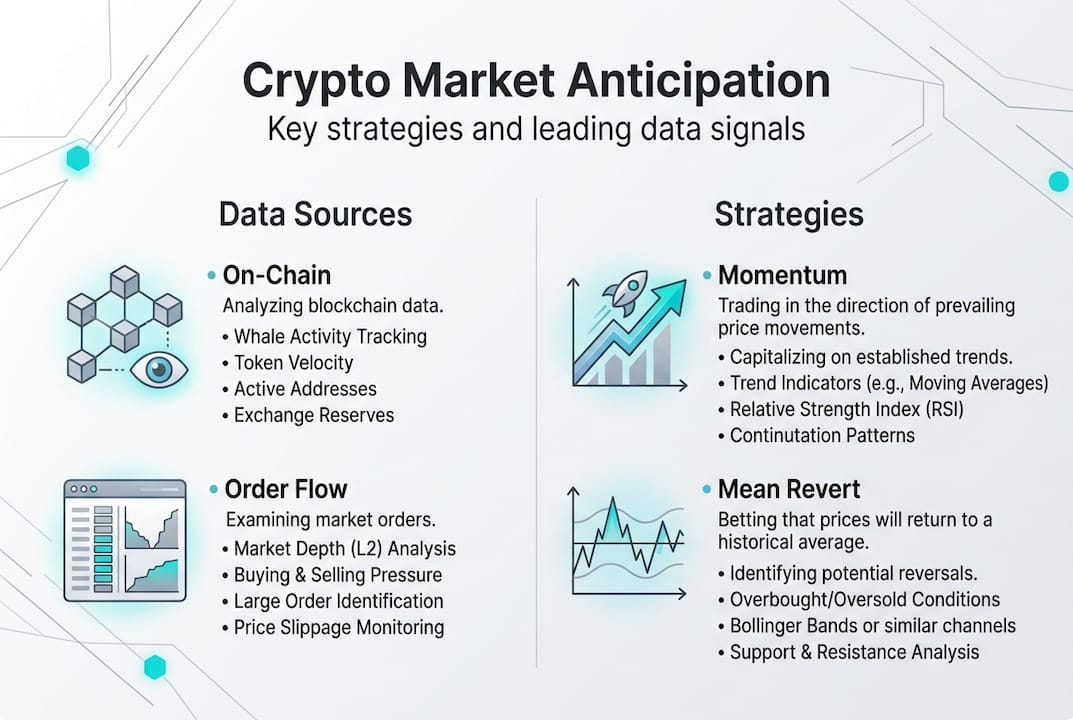
The most effective anticipation strategies draw from several distinct data categories:
- On-chain metrics: Wallet activity, exchange net flows, miner behavior, and large transfer volumes recorded directly on the blockchain
- Order flow data: Real-time order book depth, trade tape, and cumulative delta across major exchanges
- Institutional flows: ETF inflows and outflows, OTC desk activity, and custody movements
- Sentiment analysis: Social volume, fear and greed indexes, and narrative momentum across platforms
- Whale tracking: Large wallet movements, cluster analysis, and behavioral fingerprinting of known market participants
Integrating multiple signal types consistently outperforms any single-metric approach. On-chain combined with order flow and institutional data provides a measurable edge that isolated indicators simply cannot replicate. The on-chain analysis definition is a useful reference for traders building their foundational knowledge.
Each of these sources captures a different dimension of market behavior. No single one tells the full story.
Core data sources: On-chain, order flow, and institutional signals
Now that we have defined market anticipation, let us examine which data sources provide a real edge and which pitfalls to avoid.
On-chain data is the most transparent layer. Every large transfer, exchange deposit, or wallet consolidation is recorded and timestamped on the blockchain. Traders use this to track accumulation patterns, identify distribution phases, and monitor exchange reserves. However, on-chain data misses hidden OTC flows and can be delayed. A single large transaction should never be trusted in isolation. The institutional use of on-chain data has grown significantly, but even sophisticated desks treat it as one input among many.

Order flow data captures what is happening at the execution layer. Bid-ask imbalances, aggressive market orders, and cumulative delta shifts often precede price moves by seconds to minutes. The risk here is spoofing and iceberg orders. Visible liquidity in the order book is frequently manufactured to mislead. What you see is not always what is real.
Institutional flows, particularly ETF inflows and outflows, have become a critical leading indicator. ETF inflows of $1.32B have been directly correlated with Bitcoin price appreciation and key accumulation zones, demonstrating that institutional capital movement often leads retail price action.
| Data source | Key strength | Key weakness |
|---|---|---|
| On-chain metrics | Transparent, verifiable, real-time | Misses OTC flows, can lag |
| Order flow data | Captures execution intent | Vulnerable to spoofing and iceberg orders |
| Institutional flows | Leads price, signals accumulation | Often opaque, delayed reporting |
To combine these three sources effectively, follow this sequence:
- Establish baseline flows: Monitor cumulative on-chain exchange net flows over 7 to 14 days to identify directional bias
- Confirm with order flow: Look for sustained cumulative delta alignment with the on-chain directional signal
- Check institutional context: Cross-reference ETF flow data to validate whether large capital is entering or exiting
- Apply sentiment filter: Use social sentiment as a contrarian or confirming overlay, not as a primary signal
Pro Tip: Weight cumulative multi-day flows over individual whale transactions. A single large transfer can be noise. A consistent directional pattern across seven or more days carries far more predictive weight.
Key strategies and tools for anticipating crypto market moves
Equipped with an understanding of data sources, let us examine which real-world strategies and tools give traders a measurable edge.
Not all indicators perform equally. Bollinger breakout strategies performed best in volatile markets, and order flow combined with on-chain data provided measurable outperformance over single-metric sentiment tools in rigorous backtests. Meanwhile, machine learning models using GRU architecture achieved a mean absolute percentage error (MAPE) of just 0.035 for BTC price prediction, outperforming traditional statistical models by a significant margin.
The top strategies active traders use for market anticipation include:
- Multi-metric convergence: Waiting for on-chain, order flow, and sentiment signals to align before entering a position
- Supply heatmaps: Identifying price levels where large volumes of tokens were last moved, creating support or resistance clusters
- Cumulative flow analysis: Tracking net exchange flows over extended periods to detect sustained accumulation or distribution
- Whale leaderboard monitoring: Following the behavioral patterns of known large wallets through whale movement tracking rather than reacting to individual transactions
| Strategy | Market condition | Typical edge |
|---|---|---|
| Momentum + order flow | Trending markets | High, short time frame |
| Supply heatmap | Range-bound or reversal | Medium, medium time frame |
| Cumulative flow analysis | Accumulation phases | High, longer time frame |
| Machine learning signals | All conditions | High, requires calibration |
A concrete example: during Bitcoin's consolidation at $66,000 to $68,000, $1.32B in ETF inflows signaled institutional accumulation. Traders monitoring ETH whale activity alongside ETF flow data had early confirmation of a bullish posture before price broke higher. The best crypto whale tracking tools make this kind of cross-asset signal monitoring practical for active traders.
Limitations, edge cases, and what most traders miss
No strategy is perfect. Here is what expert research reveals about the edge cases and traps most traders do not see.
Lag is a persistent problem. Whale wallet deposits to exchanges can lag by a median of 47 minutes. By the time a signal appears on a dashboard, the move may already be underway. Reacting to these signals in real time is often less effective than anticipating the conditions that make them likely.
Institutional and OTC flows frequently bypass on-chain visibility entirely. Large block trades settled off-exchange leave no immediate blockchain footprint. Surface data looks clean while significant capital is moving invisibly. This is why top whale tracking solutions increasingly incorporate behavioral inference rather than relying solely on raw transaction data.
Order book data presents its own distortions. Spoofing, where large orders are placed and canceled to manipulate perceived liquidity, is common. Iceberg orders hide true size. What appears as deep support or resistance may evaporate the moment price approaches it.
Common pitfalls that experienced traders still fall into:
- Overfitting backtests: A strategy that worked perfectly on historical data often fails when market regimes shift
- Overtrusting beta hedging: Research shows beta-based hedging is only approximately 17% effective in crypto markets
- Ignoring lag recognition: Acting on delayed signals as if they were real-time creates systematic entry errors
- Chasing isolated alerts: Single whale transactions or viral on-chain events generate more noise than signal
Research confirms that 60 to 70% of smart money signals are noise. Individual whale transactions are frequently misleading. The signal-to-noise ratio only improves when behavioral patterns are observed across multiple time frames and data sources simultaneously.
Pro Tip: Use behavioral fingerprinting to track how specific wallet clusters behave across market cycles. Cumulative patterns from known participants carry far more weight than any single transaction alert.
Why true market anticipation demands skepticism and synthesis
Most professionals who struggle with market anticipation share a common failure mode: they trust a tool or a signal too completely. Popular dashboards, single-metric alerts, and even sophisticated AI outputs are all proxies for reality, not reality itself. Blind trust in any one of them creates systematic blind spots.
The real edge in crypto market anticipation is not in using more data. It is in combining, contextualizing, and repeatedly challenging the assumptions behind every signal. Multi-day, multi-signal frameworks consistently outperform reactionary trades. Chasing isolated whale moves or acting on viral on-chain alerts without broader context is how well-capitalized traders still lose money.
Market regimes shift. A signal that worked reliably in a trending market may generate false positives in a range-bound environment. Staying adaptive means continuously re-evaluating which signals are most relevant given current conditions. The professionals who sustain an edge over time are not those with the most data. They are those who remain genuinely skeptical of their own frameworks and willing to revise them. For ongoing crypto trading insights, staying current with evolving research and signal performance is non-negotiable.
Next steps: Tools to empower your crypto market edge
Ready to turn insight into advantage? Operationalizing crypto market anticipation requires more than frameworks. It requires infrastructure that delivers real-time, multi-signal intelligence without the latency that erodes edge.

SonarTracker.io brings together the data layers covered in this article into a single professional-grade platform. The ORCA AI market analyst synthesizes on-chain flows, sentiment shifts, and whale activity into actionable signals. Real-time trending alerts surface emerging momentum before it becomes consensus. The whale leaderboard lets you track behavioral patterns of the largest market participants continuously. All of this is available at zero cost, giving retail and institutional traders alike access to the same intelligence infrastructure.
Frequently asked questions
How do institutional flows impact crypto market anticipation?
Institutional flows such as ETF inflows often precede price moves and define key accumulation zones, making them one of the most reliable leading indicators available to active traders.
Why are single on-chain metrics unreliable for predicting crypto market trends?
Single metrics generate false or lagging signals at high rates; combining on-chain data with order flow and institutional signals produces a substantially more reliable anticipation framework.
What is the difference between market anticipation and market prediction?
Market anticipation focuses on positioning ahead of probable moves using converging leading signals, while prediction attempts to forecast a specific price level at a defined point in time.
What pitfalls should traders watch for when anticipating crypto markets?
Traders should account for lag effects, spoofed order book data, and overreliance on single signals, as key pitfalls include lag, noise, and high false-positive rates that distort signal quality.
Recommended
- Crypto Market Manipulation: How to Detect It in Real-Time | Sonar Tracker Crypto
- Using Community Sentiment to Trade: Bullish vs Bearish Signals | Sonar Tracker Crypto
- AI Crypto Market Analysis — Powered by ORCA | Sonar Tracker Crypto
- Blog — Whale Tracking Guides & Crypto Insights | Sonar Tracker Crypto